Departmental Standards
Company-Wide
eCornell Styleguide & Branding
Cornell University Branding
Writing and Editing Style Guide
Faculty and Expert Naming Conventions in Courses
Cornell School and Unit Names
Tips for Campus Engagements
LSG
Legal Policies
CSG
Creative Services (CSG) Handbook
Updating Wrike Due Dates
Photography Style Guide
eCornell Mini Visual Style Guide
The Pocket Guide to Multimedia Design Thinking (*as It Pertains to Your Job Here)
Administrative
LSG Meeting Recordings and Notes
Sending Faculty Sign-Off Forms in Adobe Sign
Weekly Faculty Status Emails
Animation/Motion Design
Instructional Design
AI in Instructional Design: Principles and Approach
Required Course Elements
The Pocket Guide to Instructional Design Thinking at eCornell
Adding AER to Canvas
Grading
D&D Newsletter
LSGN Newsletter December 2022
LSG Newsletter (LSGN) - February 2024
LSG Newsletter (LSGN) - March 2022 Edition
LSG Newsletter (LSGN) - December 2023
LSG Newsletter (LSGN) - October 2021 Edition
LSG Newsletter (LSGN) - June 2022 Edition
D&D Newsletter November 2024
LSG Newsletter (LSGN) - August 2022 Edition
LSG Newsletter (LSGN) - June 2023
LSGN Newsletter April 2023
LSG Newsletter (LSGN) - February 2022 Edition
LSG Newsletter (LSGN) - October 2022 Edition
LSGN Newsletter February 2023
LSGN Newsletter March 2023
D&D Newsletter September 2024
LSG Newsletter (LSGN) - August 2023
LSG Newsletter (LSGN) - March 2024
LSG Newsletter (LSGN) - April 2022 Edition
D&D Newsletter - August 2024
LSGN Newsletter January 2023
LSG Newsletter (LSGN) - October 2023 article
LSGN Newsletter (LSGN) - April 2024
LSG Newsletter (LSGN) - November 2021 Edition
D&D Newsletter February 2025
LSG Newsletter (LSGN) - January 2022 Edition
D&D Newsletter April 2025
LSG Newsletter (LSGN) - July 2022 Edition
LSG Newsletter (LSGN) - September 2022 Edition
Course Development
Image Uploads for Inline Projects
How to Install the Firefox Canvas Utilities Extension
Revising a Course/ Creating a Redux Version/ Course Updates
Creating a Perma Link With Perma.cc
Course Content Deletion Utility — Removing All Course Content
Course Names
Requesting High Resolution Video Uploads
Technical Talking Points Template
Writing Discussions: Guidelines for IDs
Online Resources in Credit-Bearing Courses
Hiring Actors for an eCornell Project
Marketing
Operations
Tech
Translate Video Captions in Kaltura for Localization
Master Course Template Differences (8675309s)
FeedbackFruits Overview
Standards for YouTube Videos Within eC Courses
Handling Curse Words
Non-CSG File Uploads
Mentored Learning Conversion Process and Resources
Doc-Based Master Course Template and Standards (8675309-DOC)
Pedagogical Guidelines for Implementing AI-Based Interactives: AER
New Canvas Accounts for Faculty Partners
Coding Master Course Template and Standards (8675309-CODE)
FeedbackFruits Implementation
Practice Quiz Standards
Hero Image
Platform Training
Administrative Systems
ADP
Google Drive
Downloadables Process
Embed a Document From Google Drive
Adding Google Links to Canvas
File Naming and Storage Convention Standards
Google Drive for Desktop Instructions
Storing Documents in Multiple Locations
Wrike
Wrike System Fundamentals
Using Search in Wrike
Field Population
1.0 to 2.0 Wrike Project Conversion
Blocking Time Off in Work Schedule (Wrike)
Wrike Custom Field Glossary
Wrike "Custom Item Type" Definitions
How to Create a Private Dashboard in Wrike
Using Timesheets in Wrike
Importing Tasks into a Wrike Project
Wrike Project Delay Causes Definitions
Setting OOO Coverage for Roles in Wrike
How to Change a Project's Item Type in Wrike
How to Create a Custom Report in Wrike
@ Mentioning Roles in Wrike
Automate Rules
Using Filters in Wrike
Managing Exec Ed Programs in Wrike
External Collaborators
Wrike for External Collaborators: Getting Started
Wrike for External Collaborators: Views
Wrike for External Collaborators: Tasks in Detail
Wrike Updates
New Experience Update in Wrike
Wrike Course Development Template 2.0 - What's New
Wrike - Course Development Template 3.0 Release Notes
Wrike Process Training
Using DnD AI Agents in Slack
Course Development & Delivery Platforms
Canvas
Development
Adding Custom Links to Course Navigation
Adding Comments to PDFs from Canvas Page Links
Setting Module Prerequisites and Requirements in Canvas
Canvas Page Functionality
Create a New Course Shell From 8675309
Using LaTeX in Canvas
Search in Canvas Using API Utilities - Tutorial
Reverting a Page to a Previous Version
Student Groups
Create Different Canvas Pages
Importing Specific Parts of a Canvas Course
Canvas HTML Allowlist/Whitelist
Understanding Canvas Customizations/Stylesheets
Operations
Discussion Page Standards
How to import a CU course containing NEW quizzes
Canvas LMS: NEW Quiz compatibility
Faculty Journal
Course Content Style Guide
Click-To-Reveal Accordions in Canvas
Course Maintenance Issue Resolution Process
Meet the Experts
Codio
Codio Operations
Managing Manually Graded “Reflect and Submit” Codio Exercises
Codio Structure and Grading for Facilitators
Premade Codio Docs for Ops & Facilitators
Codio Remote Feedback Tools for Facilitators
Developers
Development Processes
Creating a New Codio Course
Creating a New Codio Unit
Integrating a Codio Course into Canvas Using LTI 1.1
Embedding a Codio Unit into Canvas
Setting Up the Class Fork
Jasmine Autograde Unit Testing
Setting Up the Class Fork (LTI 1.3)
AWS S3 Cache Management for Codio
R Studio - Exclusion List for R Code
Mocha/Selenium Autograding
Starter Packs in Codio
Configuring Partial Point Autograders in Codio
Launch a Jupyter Notebook from VM
AI Extensions
Program-Specific Developer Notes
Codio Functionality
Jupyter Notebooks
Jupyter Notebooks - nbgrader tweaks
Jupyter Notebooks Style Guide
Creating NbGrader Assignments
Adding Extensions to Jupyter Notebooks
Setting up R with Jupyter Notebooks
Change Jupyter Notebook Auto Save Interval
How to Change CSS in Jupyter Notebook
RStudio in Codio
How To Centralize the .codio-menu File to One Location
Codio Fundamentals for LSG
Using the JupyterLab Starter Pack
Using Code Formatters
Using the RStudio Starter Pack
Conda Environments in Codio
Updating Codio Change Log
Codio Basics: Student Support
eC Facilitator Guide to Codio
Migrating to Updated Codio Courses
Qualtrics
Ally
Adobe
Other Integrations
Pendo Overview
How to Add VitalSource eBooks in Canvas
Enabling Zoom/"Live Sessions" in a Course
Pendo Guide Creation
H5P
Modifying Subtitles in H5P Interactive Videos
Embedding H5P Content Into Canvas
Troubleshooting H5P Elements in Canvas
Inserting Kaltura Videos into H5P Interactive Videos
Adding Subtitles to H5P Interactive Videos
S3
BugHerd
Instructional Technologies & Tools Inventory
Canvas API Utilities
Getting started with the MOP Bot
eCornell Platform Architecture
HR & Training Systems
Product Development Processes
Accessibility
What Is Accessibility?
What Is Accessibility?
Accessibility Resources
Accessibility Considerations
Accessibility Support and Assistive Technology
Structural Accessibility
Accessibility Design and Development Best Practices
Accessible Images Using Alt Text and Long Descriptions
Accessible Excel Files
Accessibility and Semantic Headings
Accessible Hyperlinks
Accessible Tables
Creating Accessible Microsoft Files
Mathpix: Accessible STEM
Design and Development General Approach to Accessibility
Integrating Content Authored by a Third Party
Planning for Accessible Tools
Accessibility Considerations for Third Party Tools
Studio Accessibility
Designing for Accessible Canvas Courses
Accessibility: Ongoing Innovations
Course Development
Planning
Development
0. Design
1. Codio Units
1. Non-Video Assets
3. Glossary
4. Canvas Text
4. Tools
4. Tools - Wrike Task Definitions
3. Review And Revise Styled Assets
ID/A to Creative Team Handoff Steps
General Overview of Downloadables Process
Course Project: Draft and Final
Excel Tools: Draft and Final
eCornell LSG HTML Basics
1. Non-Video Assets - Wrike Task Definitions
2. Video
Multifeed Video
2. Video (Standard) - Wrike Task Definitions
Studio Tips
Tips for Remote Video Recording Sessions
Who to Tag for Video Tasks
3. Animation
Motion Contractor Guide for IDAs / IDDs
3. Animation - Wrike Task Definitions
2. Artboard Collab Doc Prep
6b. Motion Design Review and Revise
Who to Tag for Animations Tasks
3. Artboard Collab Process Walkthrough
DRAFT - FrameIO Process Walkthrough
Requesting / Using Stock Imagery (Getty Images and Shutterstock)
3. Ask the Experts
5. On-Demand Conversion
5. Review
1. Prep Course for Reviews
3. Implement Creative Director Edits
3. Implement IDD Edits
4. CSG - Revise Tools Export 1
5. Conduct Faculty Review
6. Implement Faculty Edits
7. Conduct Technical Review of Course (STEM-only)
Technical Student Experience (Tech SE) Review Process
2. Conduct IDD or Sr ID Review
6. Alpha
6. Alpha - Wrike Task Definitions
Alpha Review Process
Prepare a course for Alpha review
Schedule & Conduct Alpha Triage Meeting
7. QA
1. Prep Course for QA
2. Copy Edit Captions
2. Copy Edit Course & Files
4. Conduct Content QA of Course
4. Final Creative Review and Export
Adding Chat With Tech Support to Course Navigation
5. Implement QA Edits
Whisper Video Transcription Process With Kaltura
Creating a Course Style and Settings Guide
Copy Editing Content in Frame.io
1. Complete Dev to QA Checklist
Course QA Checklists
8. Deployment
8. Deployment - Wrike Task Definitions
1. Finalize Master Version of Course
2. Create & Add Course Transcript (CT) to Course
Replace a Master -M With a Redux Version of the Course
Adding Facilitator Course Review Attestation to the Training Course
3. Associate -T (Training Course) With Master Blueprint
Canvas Blueprint Course Functionality
Project Management in Wrike
Managing Project Reporting in Wrike
Managing Task Needs/Schedule in Wrike
Adding Tasks
Comments and Communication
Statuses
Updating Task Start and Due Dates
Predecessors
Durations
Rollups
Calculating Project Schedule by Deadline in Wrike
Creating Course Project Plans in Wrike
Setting Custom Capacity for Resources
Customizing Effort in a New Project Plan
Marking Projects Complete in Wrike
How to Set Up Workload Charts to Track Effort in Wrike
For-Credit Considerations
1-Sheet Population
Post-Development
AI Simulations
Program Facilitation & Operational Guidelines
Data Science
Facilitator Resources
Canvas Navigation
How Do I View Previous Courses I Have Taken or Facilitated?
Why Am I Receiving Duplicate Canvas Emails?
How Do I Send Students Nudges from the Gradebook?
Adding Events to the Course Calendar
Navigating Canvas and the Dashboard
Enhanced Discussion Boards [2026]
Recording/Uploading a Video in Canvas
How Do I Edit My Canvas Profile?
Utilizing the AI-Enhanced Learners Feedback Tool
Send Students a Direct Message on Canvas
Adding Notes to Canvas Gradebook
Overview of 2024 Changes- Course Layout and Structure
How Can I Update My Canvas Notification Preferences?
Ursus Navigation
How Do I Access My Offer in Ursus?
How Do I Request Time Off (Blackout Dates)?
Adding Or Editing Ursus (Facilitator Portal) Profile
How Can I Request to Learn More Courses?
Live Sessions
Set up Live Sessions with the Facil Tool
Enabling Student Use of Closed Captioning in Zoom
When Should I Schedule My Live Sessions For?
Changing Live Session Date and Time After Created with Facil Tool
Help! I Need to Reschedule a Live Session
Live Session Information page
Combining Live Sessions with Facil Tool
Course Set-Up
What Do I Need to Do to Make Sure My Course is Set Up Correctly?
Course Set Up: Getting Ready for Live Sessions
Recording and Posting a Welcome Video
Course Set Up: When can I begin to edit my course?
Automated Nudge Feature Guide
Course Set Up: Reviewing Due Dates
Facil Time Zones Feature Guide
Course Set Up: Reviewing Announcements
Blurring Background During Video Feedback with the Speedgrader
How Do I Customize My Course Sections?
Course Announcements and Messages Templates
Facilitator Focus
Zoom and other Technical Support
How Do I Set Up My Zoom Account?
Support Resources for Facilitators
Live Session/Zoom Trouble Shooting Guide & Technical Readiness
How to Upload to Video On-Demand (VOD)
Joining the Facilitator Community Hub via Microsoft Teams
Reporting Spam/Phishing
Activating/Re-activating Duo Mobile (Two Factor Authentication)
Common Access/Login Errors
Student Survey FAQs
How Do I Save and Refer Back to Zoom Recordings?
How Do I Find My Personal ID Meeting link in Zoom?
Benefits as an eCornell Employee
Taking Courses as a Student
Do I Have Access to Microsoft Office as a Cornell Employee?
Professional Development Benefit
Student Success
Extensions and Retakes
Policies and Navigation Resources for Students
Understanding and Addressing Instances of Plagiarism
Understanding and Addressing Use of AI
Help! My Students Can't View a Video Within My Course
Identifying Learner Story & Testimonial Opportunities
Students enrolled through special groups: Corporate and VA
Unique Circumstances for Student Extensions and Retakes
Communicating with Students via Canvas
Can I Provide Students with a Letter of Recommendation?
Support Resources for Students
Help! My Student is Having a Hard Time Uploading a Video
Unique Student Situations
I Have a Student Requesting Accommodations- How Should I Proceed?
Canvas Mobile App
Messaging Students via the Canvas Mobile App
Setting up and Navigating the Canvas Mobile app
Setting up Push Notifications on Canvas Mobile
Canvas App Features for eCornell courses
New Facilitator Onboarding and Quick References
Quick reference: Systems and Accounts we use at eCornell
Quick reference guide: Key eCornell Personnel
Setting up Email Forwarding
Facilitator Onboarding at eCornell
Why Do I Have Multiple eCornell email and Canvas Accounts?
How do I Log Onto Canvas and Access eCUFT101?
How Do I Add eCornell to My Email Signature?
Training Course Review & Facilitation Authorization
What to Expect During Live Shadowing Experience
Facilitator Expectations and Grading Help
Quick Reference: Sort assignments in the Speedgrader
Rubrics for Effective Facilitation
Adding an Attempt to a Course Project
Changes in Grading Scheme: Incomplete/Complete and 75% to 85%
New (Embedded/Inline Format) How do I grade Course Projects?
Navigating the Gradebook and Accessing the Speedgrader
How do I Grade Quizzes?
(Old format) How Do I Grade Course Projects and Add Annotations?
Is There an Answer Key for my Course?
How to Monitor and Promote Student Progress
How Do I Grade Discussions?
Requirements for Discussion Board Facilitation
How Quickly Do I Need to Provide Grading to Students?
Payroll and the Monthly Scheduling Process
Codio References
Codio Quick Resources
Codio Reference: Checking for Completion Status
Codio Reference: Manually Graded Exercises
Manually Graded “Reflect and Submit” Codio Exercises
Codio Reference: Embedded quiz questions (H5P)
Codio Reference: Finding Solution Code in Codio Courses
Codio Remote Feedback Tools
Codio Reference: Ungraded exercises
Codio Reference: Autograded Exercises
Archived
Table of Contents
- What DnD AI Agents Are
- Getting Started
- How Conversations Work
- Agents, Actions, and Platform Access
- Current Agents
- All Categories
- Platform Training
- Administrative Systems
- Using DnD AI Agents in Slack
Using DnD AI Agents in Slack
 Updated
by Casey Shew
- What DnD AI Agents Are
- Getting Started
- How Conversations Work
- Agents, Actions, and Platform Access
- Current Agents
DnD AI Agents is a shared library of centrally managed AI agents built for the D&D team and used directly inside Slack. Instead of each person building and maintaining their own AI configurations, it provides the ability to have a common set of agents that already know how we work and that can perform specific, approved tasks in the platforms we use every day.
This article covers what the agents are, how to start and manage conversations in Slack, what Actions and platform guardrails mean in practice, what the currently available agents do, and how to propose new shared agents.
A Note on the Name
Normally, we refer to the team as D&D. The Slack app itself is named DnD AI Agents, without the ampersand, because Slack does not allow an ampersand in an app username.
When you search in Slack, search for DnD AI Agents. Throughout this article, D&D refers to the team and DnD AI Agents refers to the Slack app.
What DnD AI Agents Are
DnD AI Agents provides a library of purpose-built agents that live in Slack and are available to the whole team. The most important thing is that the agents are shared rather than privately configured by individual users.
Why a Shared Agent Library
Because the agents are centrally managed, several things can be maintained once for everyone rather than rebuilt by each person:
- System instructions and behavioral guidance
- AI model selection
- Tools and integrations
- API-connected capabilities
- Platform-specific Actions
- Updates to agent behavior over time
In practice, this means you should not need to recreate complicated instructions or integrations yourself. When an agent's instructions or capabilities improve, everyone on the team gets the improvement.
This kind of shared team agent library is not something every AI tool provides. For comparison, Claude CoWork desktop does not currently offer the same type of shared team agent library.
Model Flexibility
The agents are capable of leveraging models from multiple AI providers. The currently available agents use Claude Opus, but the architecture is not intended to be tied to a single model provider. The model is specified on an agent-by-agent basis, so each agent gets assigned a model, and each user that uses that agent cannot change the model.
Why Slack
Slack is a familiar interface. Depending on the agent, you can provide:
- Normal text instructions or questions
- Uploaded files
- Screenshots
- Google Docs
- Google Sheets
- Audio
- Screen recordings
Working in Slack also makes AI-assisted work collaborative. A Slack thread can include both the agent and multiple human participants, rather than isolating the AI interaction inside one person's separate desktop application.
Getting Started
To begin working with an agent:
- Send a direct message to DnD AI Agents in Slack.
- The app responds with an Agent Selector listing the available agents.
- Choose the agent that fits your task.
- Continue working with that agent in the Slack thread that results.
You do not need to know anything about how the agent is configured in order to start. Describe what you need in plain language, and provide any supporting materials in the same thread.
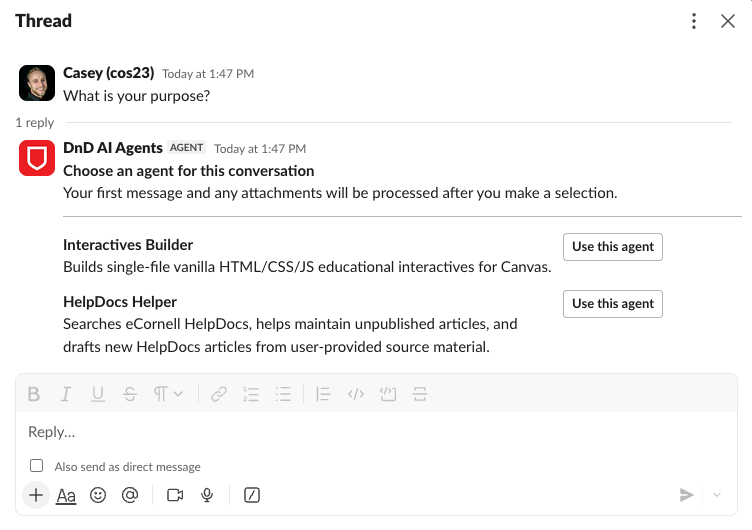
How Conversations Work
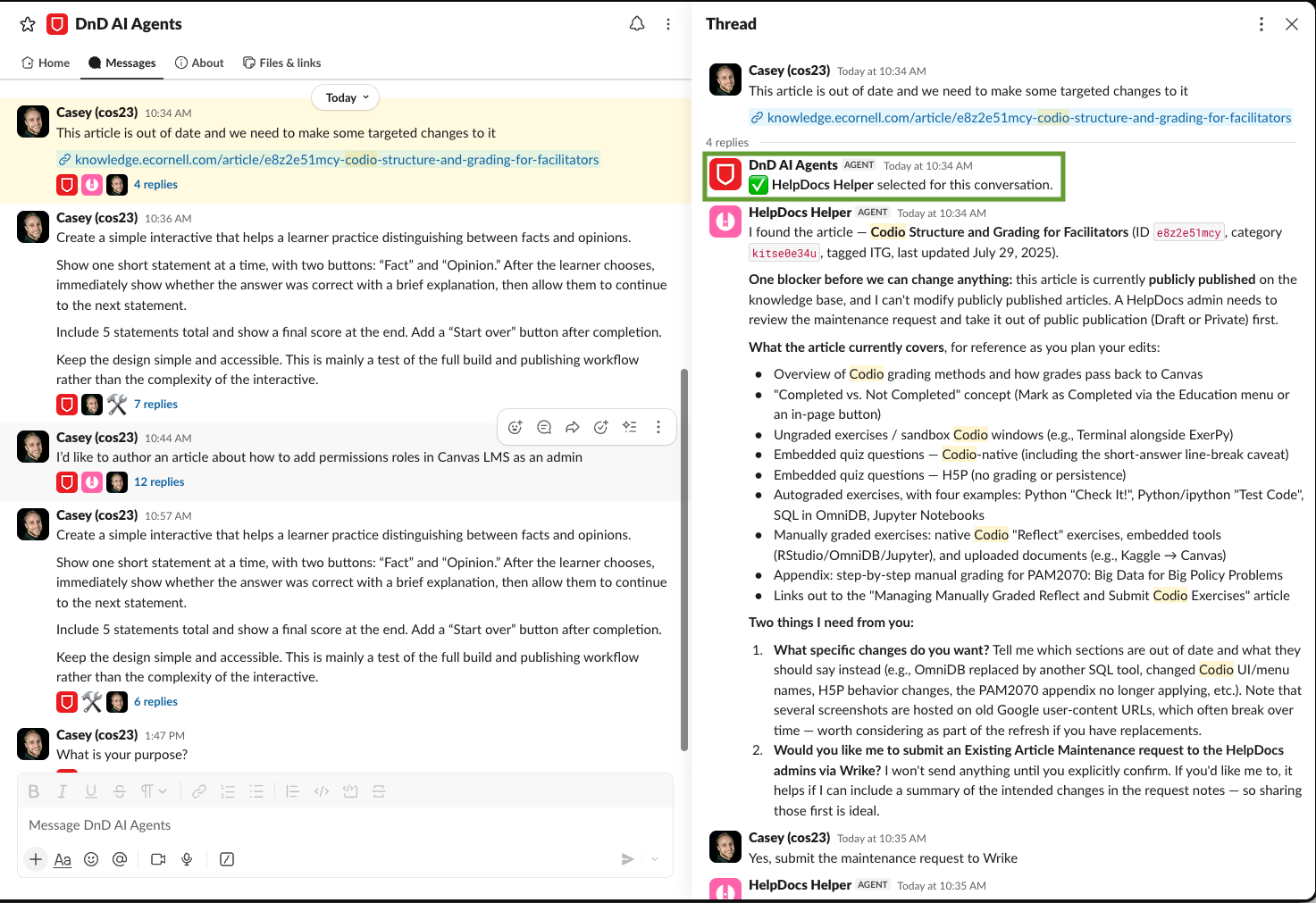
The single most useful thing to remember about the platform is this model:
One Slack thread = one agent + one request/topic
Once you select an agent for a thread, that agent stays associated with that thread. Everything you send as a reply in that thread goes to that agent, in the context of that request.
Keep Related Replies in the Same Thread
If you are refining a draft, answering the agent's questions, adding another file, or asking for a revision, reply in the existing thread. That is how the agent keeps the context of your request.
Start a New Thread for a New Topic
When you want to work on something different, or you want to use a different agent, send a new root-level message to DnD AI Agents rather than changing direction inside an existing thread. You will get the Agent Selector again and can choose the agent appropriate for the new task.
A practical way to think about it: a thread is one job. When the job changes, start a new thread.
Collaborative Conversations
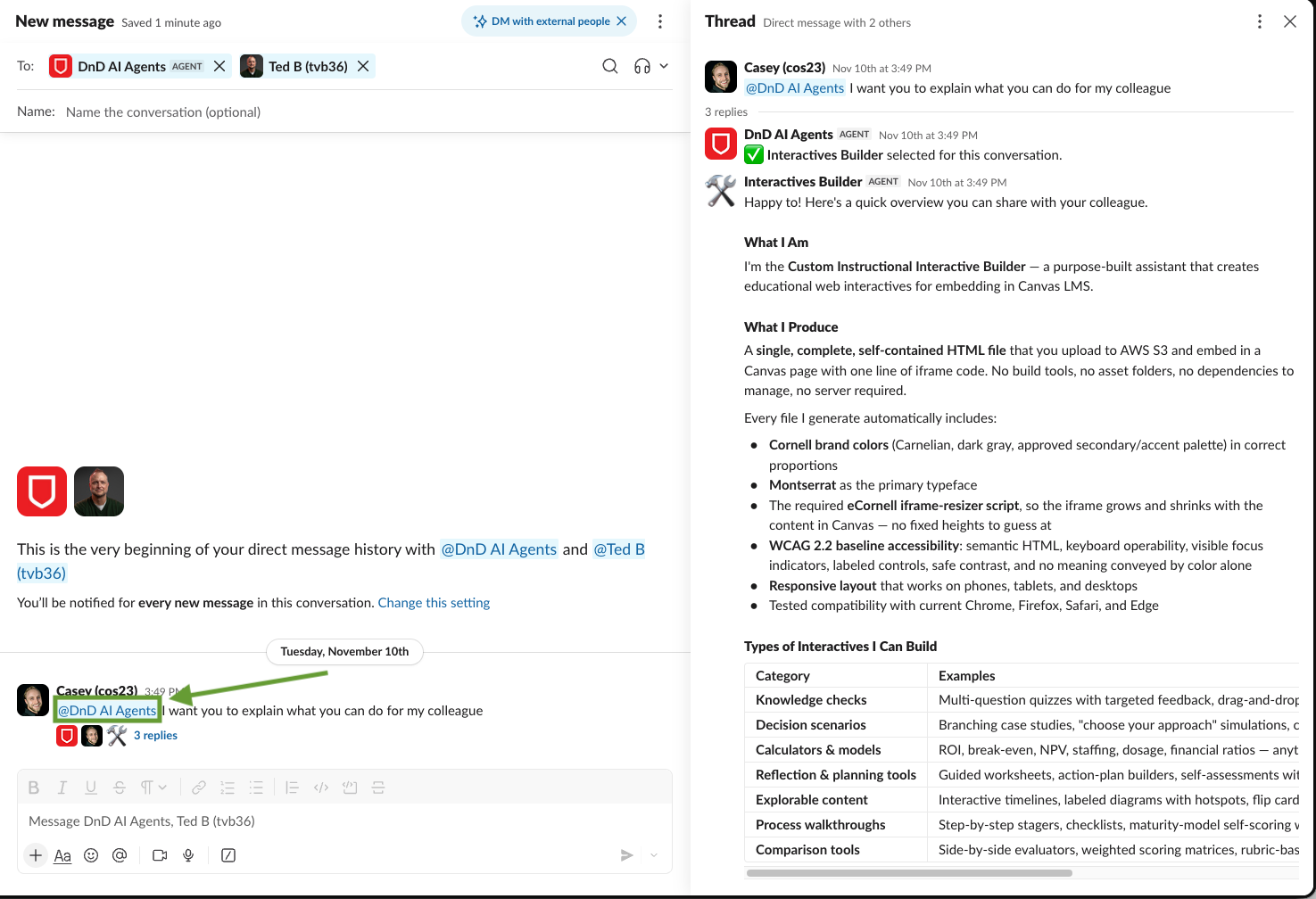
DnD AI Agents can also participate in a multi-person Slack DM. In that setting, people can discuss the work together and @mention DnD AI Agents when they want the agent to respond.
This lets a single thread act as a shared workspace that includes both the agent and several team members, which is useful when more than one person is reviewing a draft, an interactive, or a documentation change.
Agents, Actions, and Platform Access
DnD AI Agents are more than reusable prompt templates. An individual agent can be given purpose-built Actions that let it perform narrowly defined tasks in other platforms. Current and planned integrations include systems such as:
- Canvas
- HelpDocs
- Amazon S3
- Wrike
- Other D&D platforms as appropriate
A useful way to picture it:
Agent → Approved Action → Specific platform capability
The AI model interprets your request, but the Action code determines what operation can actually be performed. The model decides what you are asking for; the Action decides what is possible.
Programmatic Guardrails
That distinction matters. Platform boundaries are enforced programmatically rather than by relying on the AI model to decide whether it should stay within its permissions.
Each agent receives only the Actions and permissions required for its role. If an Action does not expose a capability, the model cannot simply decide to create that capability for itself. The architecture is intentionally designed so that agents cannot expand their own access to connected systems.
This is also why the recommended path is to use an existing DnD AI Agent, or to propose a new shared agent when a new platform-connected capability would be useful, rather than independently supplying a general-purpose AI tool with broad API credentials.
Current Agents
Interactives Builder
The Interactives Builder helps D&D team members create custom instructional interactives for use in Canvas. It is intended for situations where an instructional activity would genuinely benefit from a custom interactive experience rather than a static page or document.
You describe what you want to build conversationally instead of manually developing the HTML, CSS, and JavaScript yourself.
What You Can Provide
The Interactives Builder can work from a combination of:
- A written concept or prompt
- Reference files
- Google Docs
- Google Sheets
- Audio
- Screen recordings
- Other supporting materials provided in Slack
What It Produces
The agent creates a self-contained HTML interactive, with its CSS and JavaScript included in the same file. The result is a functioning instructional interactive, not AI-generated explanatory text about one. This agent has detailed instructions and specifications to generate interactives that are informed by:
- Our visual styleguide
- Our accessibility requirements
- Responsive mobile design best practices
- Future-proof front-end programming practices such as not relying on external libraries which might change or be deprecated
Refining the Interactive
The process is meant to be iterative. Review what the agent produced, then describe changes, point out problems, or request refinements in the same Slack thread. The agent revises the interactive from there.
Publishing to Canvas
Once you approve the interactive, the agent can use a controlled Action to publish the file to the appropriate course content folder in S3. It then provides responsive Canvas embed code that you can place into the course.
Publishing is intentionally tied to an existing valid course content folder. The agent does not arbitrarily create new locations in S3.
Typical Workflow
- Describe the interactive and provide supporting materials.
- Let the agent build an initial version.
- Review and refine the interactive in the Slack thread.
- Approve the final version.
- Have the agent publish it to the appropriate S3 course folder.
- Use the supplied responsive embed code in Canvas.
HelpDocs Helper
The HelpDocs Helper assists with finding, drafting, and updating content in the D&D HelpDocs knowledge base. It is meant to reduce the work involved in locating existing guidance and in turning raw source materials into structured, usable knowledge-base content.
Searching the Knowledge Base
The agent can search existing HelpDocs content semantically, so you do not need to know the exact wording used in the article. That makes it useful in two ways: answering questions from documentation that already exists, and checking whether related documentation exists before anyone writes something new.
Drafting and Updating Content
The HelpDocs Helper can:
- Draft new HelpDocs articles
- Help revise existing private content
- Work from existing documentation and supplied source materials
- Check for related or potentially duplicate content before creating a new article
- Produce properly formatted HelpDocs article content
Source Materials
You can give the agent source materials including:
- Files
- Screenshots
- Google Docs
- Audio
- Narrated screen recordings
For recordings, the agent can transcribe the material and use that information when drafting the article. It can also identify useful moments in a recording, extract screenshots from them, and crop those screenshots for inclusion in the documentation when a visual example materially improves the article.
Review and Publishing
The HelpDocs Helper produces a formatted unpublished HelpDocs preview for review. The workflow intentionally keeps publication under human control.
Publicly published HelpDocs articles are not directly modified by the agent. When publication or other HelpDocs maintenance requires administrative involvement, the agent will hand id off through Wrike to the appropriate HelpDocs administrators.
Typical Workflow
- Ask a question or provide source materials.
- Let the agent search existing HelpDocs content for related information.
- Draft a new article or revise appropriate private content.
- Process recordings or screenshots when useful.
- Review the private HelpDocs preview.
- Route publication or administrative maintenance through the appropriate Wrike workflow when required.
Proposing a New Agent
If you identify a capability that could be useful to multiple people across D&D, suggest it. Share the idea in #dnd_claude to gauge team interest and potential use.
The goal is not to create an agent for every individual task. Shared agents are most valuable when they package reusable instructions, tools, platform access, or workflows that would benefit multiple D&D team members.
Quick Reference
- Find it in Slack: search for the app username DnD AI Agents.
- Start work: send a DM, then pick an agent from the Agent Selector.
- Stay organized: one Slack thread = one agent + one request/topic.
- Continue a request: reply in the same thread.
- Change topics or agents: send a new root-level message.
- Work with others: add people to the DM and
@mentionDnD AI Agents when you want the agent to respond. - Build a Canvas interactive: use the Interactives Builder, refine it conversationally, then publish and embed.
- Work on knowledge-base content: use the HelpDocs Helper, review the private preview, and route publishing through Wrike when required.
- Suggest a new shared agent: post the idea in #dnd_claude.